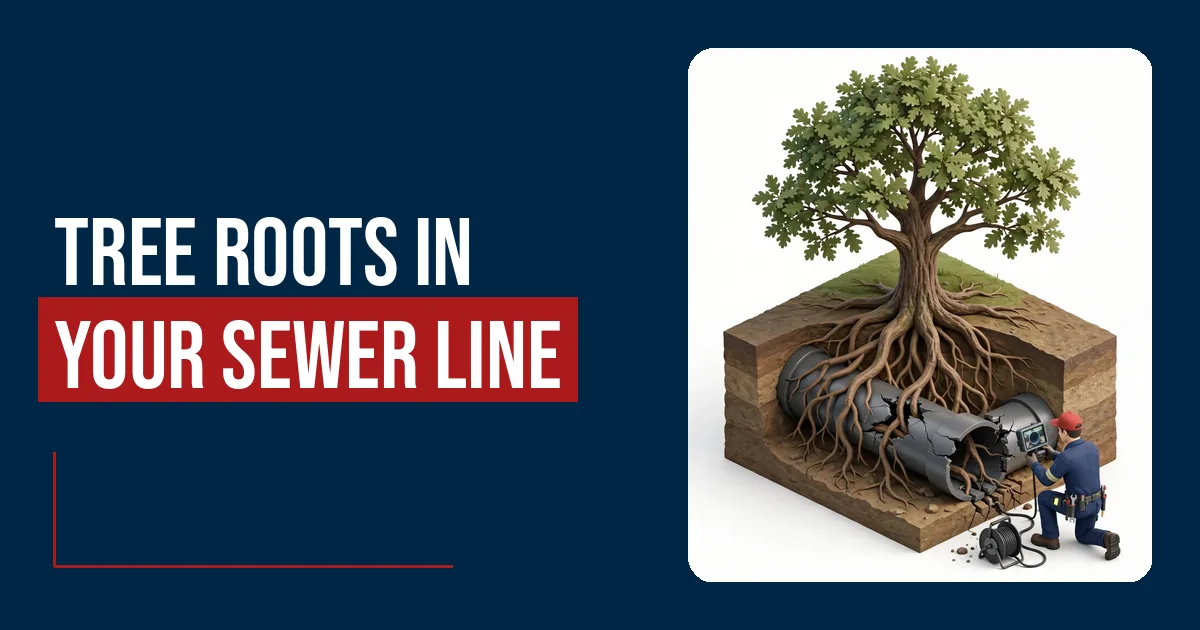
If your drains keep clogging no matter how many times they are cleared, tree roots in the sewer line are one of the most likely causes in Tyler, TX. Roots seek the moisture inside sewer pipes, enter through joints and cracks, and grow into dense masses that trap waste until the line backs up. This East Texas guide explains how roots get in, which local trees are responsible, the signs to watch for, how a camera inspection confirms the problem, and the removal and repair options that actually end it.
Pro Plumbers Tyler clears and repairs root-damaged lines across Tyler and East Texas every week. The pattern is so consistent in our older, tree-lined neighborhoods that when a homeowner describes a main line that clogs again a month after cleaning, roots are the first thing we check.
What's In This Guide
How Roots Get Into a Sewer Line
A healthy, intact pipe is root-proof. Roots get in because most older sewer lines are not intact. Sewer pipe leaves your home in sections, and every joint between sections is a potential opening. Vitrified clay and cast iron - the materials common in pre-1980s Tyler homes - develop loose joints, hairline cracks, and separated connections as decades of East Texas soil movement shift them. Expansive clay soil swells when wet and contracts in drought, and that constant movement works joints apart a fraction at a time.
The entry itself is quiet. Moisture and vapor escape through even a tiny opening, and tree roots are built to find exactly that. A root tip finer than a hair grows toward the moisture source, slips through the joint or crack, and once inside discovers a permanent supply of water and nutrients. From there it grows fast: fine feeder roots thicken into a woven mass that catches toilet paper, grease, and waste moving through the line. Each flush adds to the plug. Meanwhile the root keeps thickening at the entry point, prying the joint further apart and sometimes cracking the pipe outright - which lets in more roots.
That is why root problems accelerate. A line that took twenty years to develop its first intrusion can go from an occasional slow drain to repeated backups within a couple of seasons once a root mass is established inside it.
The Tyler Trees Most Likely to Invade Your Line
Not every tree is an equal threat. The species our plumbers find again and again in Tyler sewer lines are the ones already named across our own service pages, because they dominate the mature neighborhoods where the oldest pipes are:
- Live oak - wide-spreading, long-lived, and planted throughout Tyler's older districts. Its root system is extensive and persistent, and it does not go dormant in an East Texas winter.
- Sweet gum - fast-growing with aggressive, moisture-seeking roots; a frequent culprit where lines run near the drip line of the tree.
- Pecan - a deep, vigorous root system and a East Texas staple; pecan roots are regularly found in clay tile lines on older lots.
- Pine - the Piney Woods signature tree. Pine roots spread widely in our sandy upper soils and find sewer joints reliably.
Distance matters less than homeowners expect. Roots travel well beyond the canopy of the tree, so a line does not need to pass under the trunk to be at risk - passing anywhere within the root zone of a mature live oak, sweet gum, pecan, or pine is enough, especially where the pipe is clay or cast iron with aging joints.
Signs Roots Are in Your Sewer Line
Root intrusion announces itself through the main line, not a single fixture. Watch for:
- Multiple drains slow at once - the blockage sits in the shared main line, so sinks, tubs, and toilets all drain poorly.
- Gurgling toilets - air displaced by the root mass bubbles back through the lowest fixtures when water drains elsewhere.
- Backups that keep returning - a cleaning restores flow, then weeks or a few months later the line clogs again in the same way. Roots regrow; that is the tell.
- Sewage odor in the yard - escaping wastewater at a cracked, root-split joint can produce a persistent sewer smell outdoors and unusually lush, green grass over the line.
- Sinkholes or soggy patches - a joint pried open by roots leaks water into the surrounding soil, softening the ground above the line.
Compare that with a single slow shower drain, which is almost always hair and soap in that fixture's own trap. Root problems are whole-house problems. Our guide to a sewer camera inspection explains how each of these symptoms maps to what the camera finds.
Camera Confirmation: Seeing Is Believing
Guessing wastes money - clearing a line that is actually cracked, or digging up a line that only needed cleaning. A sewer camera inspection removes the guesswork. A waterproof camera is fed through the cleanout and travels the full run of the line while the plumber watches the live feed. With roots, the picture is unmistakable: pale feeder roots waving from a joint, or a dense root ball filling the pipe, with waste backed up behind it.
Just as important, the camera records the distance from the cleanout to the intrusion, so any repair targets the exact section instead of the whole yard. It also answers the question that decides everything else: is the pipe itself still sound? Roots entering one joint in a solid pipe are a very different job from roots that have split, offset, or collapsed sections of the line. You see the same footage we do before any recommendation is made.
Drains Clogging Again and Again? It May Be Roots.
Pro Plumbers Tyler provides licensed sewer repair in Tyler, TX, starting with a camera inspection that shows you exactly what is in your line before any work is quoted.
Call (903) 707-8889Root Removal Options
Removal clears the blockage; it does not, by itself, fix the opening the roots came through. The two professional removal methods are:
Mechanical cutting. A cable machine fitted with a cutting head is run through the line, slicing the root mass out of the pipe. It is effective for established root balls and restores flow in a single visit. The cut roots are flushed out of the line, and a follow-up camera pass confirms the pipe is clear - and shows the condition of the entry point.
Hydro jetting. High-pressure water scours the pipe wall, stripping out fine feeder roots, grease, and scale that a cable can leave behind. It is often paired with cutting on heavily rooted lines: cut the mass out first, then jet the wall clean so waste has nothing to catch on while the repair decision is made.
Repair and Replacement: Ending the Cycle
The permanent answer depends on what the camera shows:
- Targeted repair - roots at one joint or one cracked section in an otherwise sound pipe can be fixed by repairing that section alone, sealing the entry point the roots were using.
- Sewer line replacement - when roots have entered at many joints, sections have collapsed or offset, or the pipe is simply at the end of its life, replacing the line ends the cycle entirely. A new line has tight, modern joints that give roots no way in.
The honest dividing line is the pipe's overall condition, and it is exactly what the camera footage shows you. We walk through that footage with you and explain which side of the line your pipe falls on before quoting either path, with upfront flat-rate pricing in writing.
Keeping Roots Out for Good
- Camera-inspect on a schedule. If you have pine, oak, or sweet gum trees near the line, inspect every one to two years so intrusion is caught while it is still a cleaning job.
- Fix the entry point. Removal without repair is a countdown to the next backup; sealing the joint or section is what breaks the cycle.
- Plant with the line in mind. Keep new trees - especially live oak, sweet gum, pecan, and pine - away from the sewer line's path when you have a choice of planting spots.
- Act on the first whole-house slowdown. Multiple slow drains and gurgling are early warnings; a camera check then is far cheaper than a backup later.
Pro Plumbers Tyler serves Tyler, Whitehouse, Lindale, Bullard, Chandler, Kilgore, Gladewater, and surrounding East Texas communities with camera inspections, root removal, sewer repair, and full line replacement - with 24/7 emergency service when a backup cannot wait.
Frequently Asked Questions About Tree Roots in Sewer Lines
Roots do not break into a sound pipe. They enter through openings that already exist - loose or separated joints, small cracks, and the connections on older vitrified clay and cast iron lines. A hair-thin root tip finds the moisture escaping at a joint, grows toward it, and thickens inside the pipe, where water and nutrients are available year-round.
The classic pattern is a main line that clogs again and again: multiple drains slowing at once, gurgling toilets, backups that return weeks after a cleaning, and sewage odors in the yard. A single slow fixture is usually a local clog; the whole house misbehaving points to the main line.
Chemical root treatments can slow regrowth, but they do not remove a root mass that is already blocking the pipe, and they do nothing about the crack or joint the roots entered through. The opening remains, so the roots return. Mechanical removal followed by pipe repair or replacement is the lasting fix.
If you have pine, oak, or sweet gum trees near the line, a camera inspection every one to two years catches root intrusion early, while it is still a cleaning job rather than a repair. Older clay and cast iron lines deserve the closest watch.
Not always. If the camera shows one intrusion point in an otherwise sound pipe, a targeted sewer repair at that section can be enough. Replacement is the better call when roots have entered at many joints, the pipe has collapsed in places, or the line is at the end of its service life.