Snaking and hydro jetting both clear drains, but they do it in fundamentally different ways - and picking the wrong one either leaves the clog's cause behind or, in the wrong pipe, can do harm. Snaking punches through a blockage with a rotating cable; hydro jetting scours the entire pipe clean with high-pressure water. This guide explains how each works, which clogs suit which method, why a camera inspection should come first, and the one situation where jetting is the wrong tool entirely.
What's In This Guide
How Each Method Works
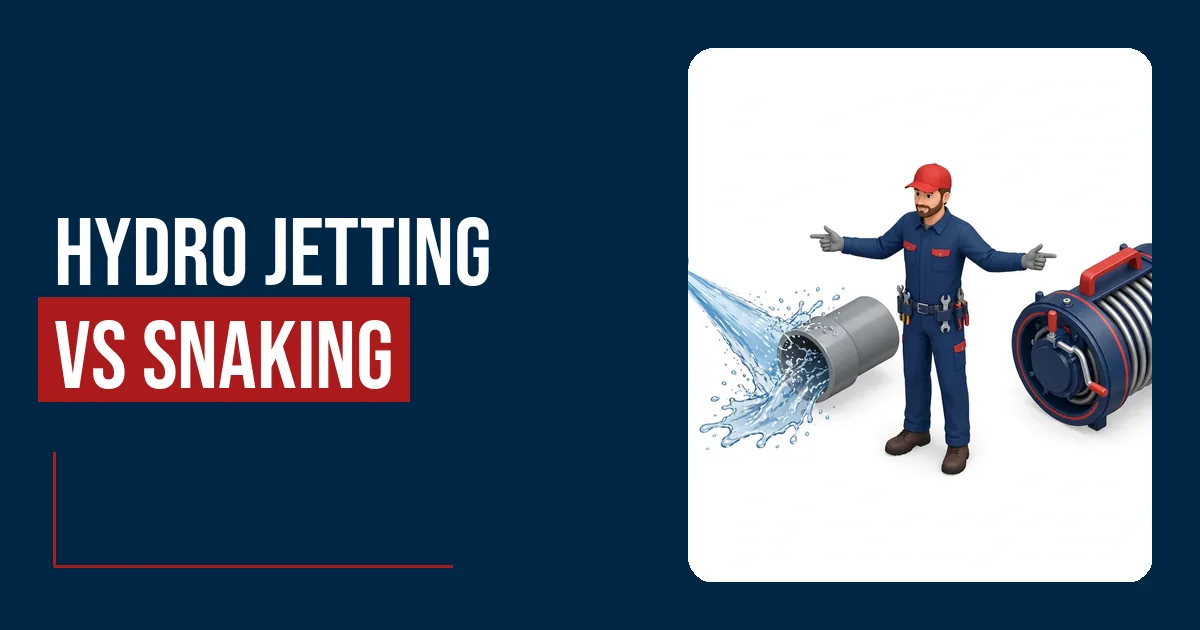
Snaking uses a flexible steel cable with a cutting or retrieving head, fed into the drain and rotated by machine. The head bores through the blockage, breaks it apart, or hooks it so it can be pulled back out. When the cable comes out, water flows again - through the path the cable opened. What snaking does not do is clean the pipe walls: grease coating, scale, and sludge beyond the cable's path stay where they were.
Hydro jetting sends a specialized nozzle through the line on a high-pressure hose. Jets of water cut backward and forward, stripping grease, soap buildup, mineral scale, and sludge off the pipe wall and flushing everything downstream. Done properly, the pipe is not just unclogged - it is close to its original diameter again, which is why jetted lines stay clear longer. See the service detail on our hydro jetting page.
| Snaking | Hydro Jetting | |
|---|---|---|
| Action | Bores through or retrieves the blockage | Scours the full pipe wall with pressurized water |
| Result | An open path through the clog | Pipe restored close to full diameter |
| Best for | Single, localized clogs; retrieving objects | Grease, scale, sludge, recurring clogs, main lines |
| Pipe walls afterward | Buildup largely remains | Buildup removed |
| Caution | May not solve the underlying cause | Not for damaged or fragile pipe - camera first |
Which Clogs Suit Which Method
- Hair and soap clogs in one bathroom drain: snaking is usually enough - the mass is localized and retrievable.
- A dropped object or a child's toy: snaking, because the goal is retrieval, not cleaning.
- Grease-heavy kitchen lines: hydro jetting - a cable just tunnels through grease, which closes back in; jetting removes it.
- Recurring clogs anywhere: jetting after a camera check, because recurrence means buildup or a pipe issue, not bad luck.
- Main sewer lines with sludge and scale: jetting restores flow across the whole line; tree-root masses may need cutting first, then jetting to finish.
- Hard-water scale narrowing East Texas pipes: jetting is the method that actually removes mineral buildup from the walls.
For how method choice feeds into pricing, see our guide to drain cleaning cost in Tyler, TX.
Why the Camera Comes First
Neither method should be chosen blind. A sewer camera inspection shows what is actually in the line: soft buildup that jetting will erase, a root mass that needs cutting, a bellied section that collects waste no cleaning can fix, or a cracked pipe that changes the whole plan. The camera takes the guesswork out of the decision - and protects you twice: you do not pay for jetting a line that only needed a cable, and nobody jets a line that cannot take it.
Not Sure Which One Your Drain Needs?
Pro Plumbers Tyler starts with a camera look when the pattern calls for it, then uses the method your pipe actually needs - quoted upfront, flat-rate, across Tyler and East Texas.
Call (903) 707-8889When Jetting Can Harm Old Pipes
Hydro jetting is powerful, and power has to respect the pipe. In a sound line, jetting is safe and thorough. In a pipe that is cracked, corroded thin, crushed, or separating at the joints - conditions found in some older Tyler homes - high-pressure water can widen existing damage or force water through failing joints. That is not a reason to avoid jetting; it is the reason the camera inspection comes first. If the pipe is fragile, the honest recommendation may be a gentler cleaning now and a repair conversation, rather than jetting a line that cannot handle it. Our drain cleaning service follows that camera-first order on every questionable line.
A Simple Decision Guide
If you remember nothing else, remember this sequence. First, locate the problem: one fixture or several? A single slow drain with no history usually means a simple, localized clog, and snaking is the proportionate first step. Several fixtures, a main-line pattern, or a clog that keeps coming back means the line itself is telling a story - and that story needs a camera before it needs a cleaning method. Second, match the method to the material: soft, greasy, scaly buildup calls for jetting's full-wall clean; a discrete obstruction calls for the cable. Third, respect the pipe: older lines get inspected before they get pressure. Homeowners do not need to make these calls themselves - but now you know what a careful plumber is doing and why, and you can spot the difference between a considered recommendation and a guess with equipment.
One last pattern worth knowing: drains rarely fail in isolation from the house's habits. Grease down the kitchen sink, wipes in the toilet, and hard-water scale are the repeat offenders behind most Tyler drain calls. Clearing the line solves today's problem; adjusting the habit - and jetting away the years of buildup the habit left behind - is what keeps the problem from rebooking itself.
Frequently Asked Questions About Hydro Jetting vs Snaking
Snaking bores a path through a blockage with a rotating cable, leaving pipe-wall buildup behind. Hydro jetting uses high-pressure water to scour the entire pipe wall clean, removing grease, scale, and sludge and restoring the pipe close to its full diameter.
Hydro jetting. A cable tunnels through grease and the tunnel closes again as the grease re-settles. Jetting strips the grease off the walls and flushes it out, which is why kitchen lines stay clear far longer after jetting.
The camera shows the pipe's real condition - buildup, roots, bellies, or cracks. That determines whether jetting is appropriate at all: a cracked or fragile pipe can be damaged by high-pressure water, while a sound but dirty pipe is exactly what jetting is for.
It can, if the pipe is already cracked, heavily corroded, or separating at joints - pressure can widen existing damage. In sound pipes it is safe. This is why a camera inspection should always precede jetting on older lines.
For a single localized clog - hair in one bathroom drain, a simple obstruction, or retrieving a dropped object - snaking is effective and appropriate. It is also a sensible first step when the clog's cause is simple and the line has no history of recurring problems.