Hard water is the default in Tyler, TX - the local supply is naturally hard and mineral-rich - and its signs show up everywhere: white scale crusting your faucets, spots on every glass, dry skin after a shower, and a water heater that gives up years early. This guide lists the signs to check in your own home, explains plainly what water softeners and filtration each do (they are not the same tool), and why a water test should come before any equipment decision.
At Pro Plumbers Tyler we install softeners and filtration across East Texas, and the first thing we tell homeowners is this: do not buy treatment for water you have not tested. The signs below tell you hard water is likely; the test tells you exactly what to do about it.
What's In This Guide
Why Tyler Water Is Hard
Hardness is simply dissolved calcium and magnesium picked up as water moves through mineral-bearing ground and aquifers. Tyler's supply - drawn from the Carrizo-Wilcox Aquifer system and local sources - is naturally hard and mineral-rich, as our own water filtration team notes when explaining the local signs to homeowners. That geology is not a defect and the water is treated to municipal standards; hardness is a household problem, not a safety verdict. But it is a real, cumulative problem for your plumbing, fixtures, and appliances, and East Texas homes feel it faster than homes in soft-water regions.
Well water around Smith County can be harder still, and often arrives with iron, manganese, or hydrogen sulfide alongside the hardness - one reason well homes should never copy a city neighbor's treatment setup without their own test.
The Signs Your Home Needs a Softener
Work through this list in your own kitchen and bathrooms. Two or three of these together is a strong hard-water pattern:
- Scale on fixtures - white or chalky crust building up on faucet tips, showerheads, and around tap bases; shower doors that stay cloudy no matter how you clean them.
- Spotty dishes - glasses and dishes come out of the dishwasher with spots and a dull film, even with rinse aid and a clean filter.
- Dry skin and dull hair - skin feels dry or itchy after showering and hair loses its softness, because hard water leaves a mineral-and-soap residue and makes soap and shampoo lather poorly.
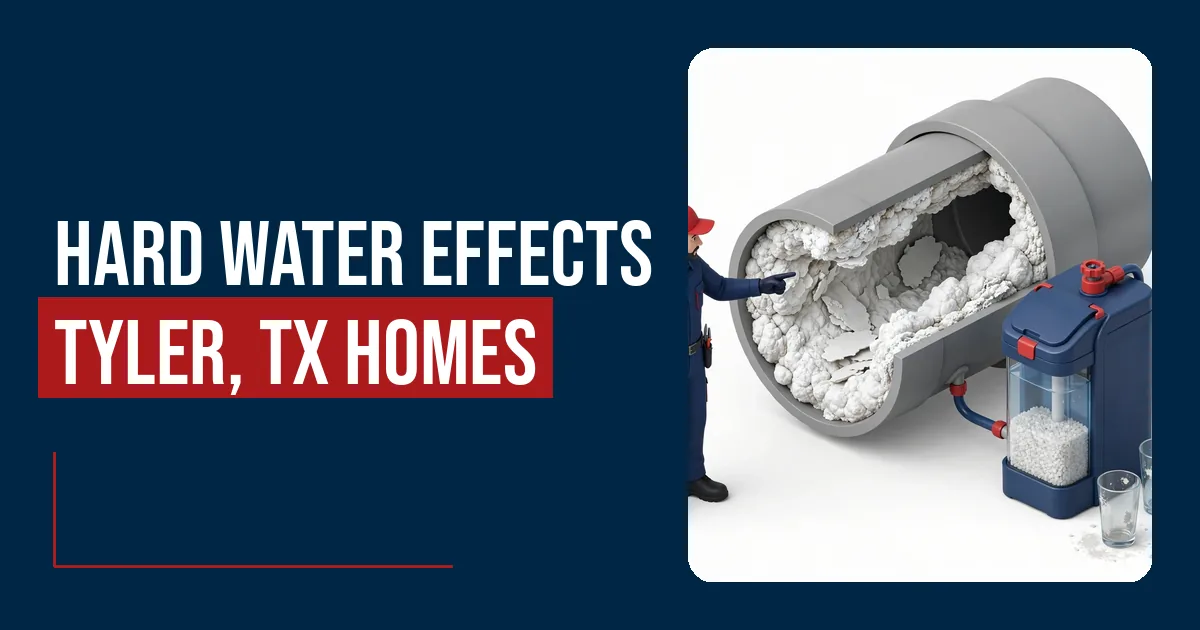
- Appliance wear - the water heater rumbles, loses efficiency, or burns out elements repeatedly; dishwasher and washing machine performance fades early. Scale coating a heating element is insulation in exactly the wrong place.
- Stiff, fading laundry - towels feel scratchy, whites grey out, and detergent seems to underperform - minerals are consuming it before it can clean.
- Scale inside pipes - the invisible one: mineral buildup narrows pipes over years, which can slowly reduce flow and give clogs more to catch on.
What Softeners and Filtration Actually Do
These two systems are sold side by side and confused constantly, so here is the plain distinction our plumbers give at the kitchen table:
| System | What It Removes | What It Does Not Do |
|---|---|---|
| Water softener | Calcium and magnesium, by ion exchange - the minerals that cause scale | Does not filter chlorine, iron, sulfur odor, or sediment |
| Water filter | Targets specific issues by media: carbon for chlorine and taste, iron filters for rust, sediment filters for particles | Does not soften water or stop scale |
| Reverse osmosis (point-of-use) | A broad range of dissolved contaminants at one tap, usually the kitchen | Treats drinking/cooking water only - not showers, laundry, or appliances |
In practice, many Tyler homes end up with a softener to stop scale plus filtration matched to whatever else the test finds. Whole-home treatment handles every fixture at the main line; point-of-use treatment handles one tap for drinking and cooking. The right combination is a test result, not a package.
Seeing Scale, Spots, and Dry Skin?
Pro Plumbers Tyler tests your water first, then quotes the treatment your result actually calls for - water filtration and softener service in Tyler, TX with upfront flat-rate pricing.
Call (903) 707-8889Testing First: The Step That Saves Money
A water test answers three questions that decide everything: how hard is the water, what else is in it, and how much flow does the home need treated? Without those answers, homeowners routinely buy a softener for a problem that is partly iron, or filtration for a problem that is mostly hardness - and then conclude that treatment "doesn't work." It works when it is matched.
Testing also sizes the equipment. An undersized softener regenerates constantly and still lets hard water through at peak demand; an oversized one costs more than the home needs. Your price for any system depends on your water chemistry, the flow rate your home needs, and how many treatment stages the test calls for - which is why we test, then quote a flat rate in writing.
When to Call a Plumber
Call when two or more signs on the list are present, when a water heater element fails for the second time, when scale is visibly narrowing showerheads and aerators, or when you are on well water that has never been tested. Pro Plumbers Tyler serves Tyler, Whitehouse, Lindale, Bullard, Chandler, and surrounding East Texas communities with testing, softeners, and water filtration - and 45+ years of local experience with exactly this water.
Frequently Asked Questions About Hard Water in Tyler
The clearest signs are white crust or scale building up on faucets and showerheads, spots and film on dishes and glassware after washing, dry or itchy skin and dull hair after showering, stiff laundry, and appliances - especially the water heater - wearing out or losing efficiency sooner than expected. Tyler's water is naturally hard and mineral-rich, so most local homes show at least some of these.
A softener removes the calcium and magnesium that make water hard, using ion exchange - that stops scale, and only that. It does not filter chlorine, iron, or sulfur smells. A filter does the opposite job: carbon media for chlorine and taste, iron filters for rust, sediment filters for particles. Many Tyler homes need one of each, which is why testing comes first.
Yes. A test tells you how hard your water actually is and whether anything else - iron, manganese, hydrogen sulfide - is present alongside the hardness. That result decides whether you need a softener alone, filtration alone, or a combination, and it sizes the equipment to your home's flow so it works at every fixture.
Yes, gradually. Scale narrows the inside of pipes, coats water heater elements so they work harder and fail sooner - repeat element failures are one of the classic local signs - and builds up in dishwashers, washing machines, and fixtures. Softening stops that accumulation, which is why it extends appliance life.
It adds a small amount of sodium, not salt as such, in exchange for the calcium removed - the harder the water, the more sodium. Anyone on a restricted-sodium diet can use potassium chloride in the softener instead, and drinking water can also be run through a point-of-use filter at the kitchen tap.